All-round effect of growth on economy










China's GDP grew by 2.3 percent in 2020 to reach 101.59 trillion yuan ($15.66 trillion), achieving better than expected results in most sectors and crossing the threshold of 100 trillion yuan. China now accounts for 17 percent of the global economy, and its per capita GDP of close to $11,000 places it among the upper-middle-income countries, narrowing its gap with high-income countries.
The International Monetary Fund has forecast that the global economy will shrink by 4.4 percent in 2020. So China's 2.3 percent economic growth, which is more than 6 percentage points higher than the global average, testifies to the resilience of the Chinese economy.
China's GDP in 1978 was only 367.9 billion yuan. Which means China's GDP has increased by about 40 times since the launch of reform and opening-up. The fast paced growth has also made China the world's second-largest economy, after the United States.
Over the past four decades, about 70 countries have experienced per capita GDP growth between 1 and 2 percent, 20 to 30 countries between 2 and 3 percent, including the US, and 20 between 3 and 5 percent. Only two countries have seen per capita GDP growth of more than 5 percent, one of which is China, at around 8 percent.
There is a correlation between per capita GDP and per capita disposable income in that higher per capita GDP usually means higher disposable income and higher living standards. Over the past four decades, China's per capita GDP has grown at rapid pace to reach almost $11,000. And although compared with high-income countries like the US and Japan, China's per capita GDP still lags far behind, it is catching up with the global average of $11,312.
Besides, China's per capita GDP of about $11,000 is a 27-fold increase since the launch of reform and opening-up, which can also be interpreted as a 27-fold improvement in the living standard of the Chinese people. That residents have more money to spend is good for the consumption growth.
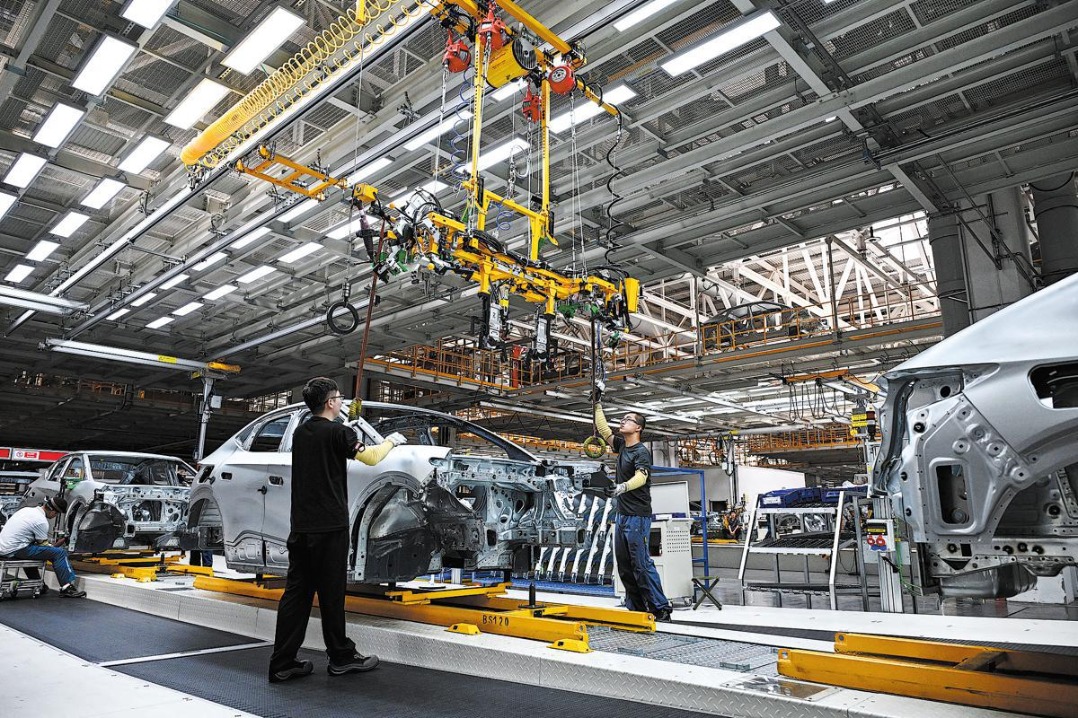
And on the production side, national and per capita GDP growth means manufacturers making more products-and service providers offering more services-and healthy market competition prompting them to improve the quality of their products and services.
China's real per capita income has doubled roughly every seven to 10 years over the past 40 years, so the country's demand structure has been changing every seven to 10 years, whereas in the US, real per capita income has doubled roughly every 30 years. Which means what happens to the demand side in the US every 30 years is happening in China every seven to 10 years.
Also, income distribution in China has become more equitable in recent years. Studies show that from 2013 to 2019, the average annual income growth rate of the high-income group was about 7.9 percent and that of the low-income group 8.4 percent. By contrast, the gap between the rich and poor in many parts of the world, including the US, has widened over the past few decades and the so-called middle class's income, in essence, not increased.
Thanks to China's development model, the incomes of different groups have grown at a more balanced rate and the country has been able to eradicate absolute poverty and promote inclusive development.
However, despite its impressive economic performance, the gap between China and the developed world cannot be ignored. For instance, China's per capita GDP of about $11,000(or $15,000 based on purchasing power parity) is only one-fourth that of the US. That is to say there is still a big gap between China and the developed countries.
Moreover, for the US, due to its advanced agricultural technology and very high total factor productivity, only 1 percent of its labor force is engaged in the agricultural sector and yet they can achieve food security. And while the US is one of the world's major grain exporters, the Central Economic Work Conference held in December said China still needs to solve the problem of seeds and arable land to ensure total food security.
In terms of industry, the developed countries represented by the US excel in basic research with their enterprises having high research and development capabilities. Indeed, China has been strengthening its R&D sector over the past years to catch up with the advanced economies, but the gap formed because of historical reasons is impossible to bridge in a short time. Yet China is determined to reach the highest levels of scientific and technological development, and thanks to sustainable economic growth, it will achieve that goal.
The author is a professor at the Guanghua School of Management and director of the Institute of Economic Policy Research, Peking University.
The views don't necessarily reflect those of China Daily.