A new gov't and future of Japan-China ties









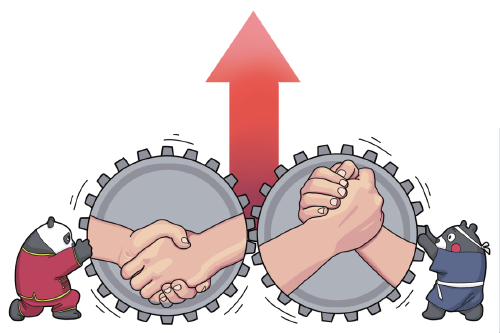
Fumio Kishida became the 100th prime minister of Japan, and a new Cabinet took office in the country on Oct 4. Although there will be a general election on Oct 31 and it is still too early to predict the future political situation in Japan in the aftermath of Yoshihide Suga's resignation as prime minister, I would like to see Kishida fulfill his mission as long as he stays in power.
Steering the wheel of Japan's diplomacy and security policy, the Kishida Cabinet's task is particularly important at a time when the situation across the world including in East Asia has become unstable due to the intensified competition between the United States and China. Unfortunately, the Kishida Cabinet's diplomacy and security policies are very likely to be an extension of those of former prime minister Shinzo Abe.
Kishida's victory in the Liberal Democratic Party's presidential election on Sept 29 was largely due to the support of former Abe and former vice-president Taro Aso. Kishida will not be able to ignore Abe's opinions, especially in terms of foreign and security policies. In the latter half of his term, Abe tried to maintain a certain balance between the US and China, but since resigning as prime minister he has not abstained from his hawkish remarks.
Sanae Takaichi contested well the LDP presidential election and won the post of a chair of the LDP's Policy Research Council. This fact means that more right-wing conservatives have extended their influence among the party's parliamentary representatives and ordinary members.
They are the people who are trying to turn back the historical clock and insisting that ministers visit the Yasukuni Shrine, which honors 14 class-A among other war criminals. So it is necessary to pay close attention to how much power Kishida, who will be under pressure from conservatives, can exert in order to realize Japan's true national interests and just historical perception.
There are quite a few areas of cooperation between Japan and China that are win-win for both sides, such as environmental protection, energy generation, education and social security. Of course, the economy is also one of them. Although trade between Japan and China in 2020 decreased compared with 2019 for the second consecutive year, the ratio of trade with China to Japan's total trade reached a record high of 23.9 percent.
In order to recover from the novel coronavirus pandemic, it is essential for Japan to strengthen its economic relations with China in many areas including tourism. If the pandemic is effectively controlled, Japan will gradually lift the ban on overseas travel, starting with the business sector. And as long as the objective criteria are met, people-to-people exchanges with China should also resume along with those with other countries.
Former US president Donald Trump ??put economic security on the forefront of the US foreign policy. The Joe Biden administration, too, is planning to reduce the US dependence on the supply chains of China and shut out Chinese companies from the advanced information and communications technology field.
Influenced by this, the Japanese government is also gradually emphasizing economic security, and Kishida has appointed a new minister in charge of economic security, Takayuki Kobayashi. Standing behind him is Akira Amari, the new secretary-general of the LDP and the most powerful right-wing advocate of Japan's economic security against China.
However, China is not only a huge production base and consumer market, but also a technologically advanced country with the largest number of patents per annum. Even if the Japanese government tries to adopt a discriminatory economic policy toward China using security as an excuse, private businesses will be slow to move in that direction. I think the idea of economically containing China is not only unrealistic, but also a lose-lose proposition for both sides.
The intensifying tensions between the US and China will have a major impact on Japan, which is an ally of the US as well as a close neighbor of China. Frankly speaking, the Japanese people's feelings toward China have deteriorated in recent years. Many Japanese people think that a conflict with China is inevitable, and the number of people hyping up tensions between the two sides is not small. But this situation does not serve the national interest of Japan.
It is especially disturbing that we have seen more remarks and deeds concerning Taiwan both in Japan and the United States. No matter which way the US administration moves in the future, the Japanese government should never deviate from the "one-China" policy that the two sides agreed to when diplomatic relations were normalized.
It is also wise to nip potential conflicts between Japan and China in the bud. I think the territorial disputes that are pending between the two countries should be shelved for the time being, and both sides should take a long-term approach toward this issue.
We will celebrate the 50th anniversary of the normalization of diplomatic relations between Japan and China next year. We should take advantage of this opportunity to improve the precious bilateral relationship.
Although there is the uncertain factor of the COVID-19 pandemic, I would like to see deepening exchanges between the political leaders, government officials, and the private sectors of the two countries. Talks between the top leaders are of particular significance. While the top leaders of Japan and the United States have met several times, the current situation where Japanese and Chinese top leaders cannot meet is simply unhealthy.
Kishida has said that "listening to the stories of others should be the starting point of building trust" and claimed that he has the best "listening ability". The basis of Japan-China relations is trust. Prime Minister Kishida and President Xi Jinping should overcome differences between their countries and systems to create an opportunity to hold talks based on mutual respect, mutual understanding and mutual support. It doesn't matter where they meet.
Irrespective of how difficult the challenges may be, it is in the interests of both countries to maintain and develop stable bilateral relations. We should never forget that.
The author is former prime minister of Japan.
The views don't necessarily reflect those of China Daily.