Striving to build a modern society









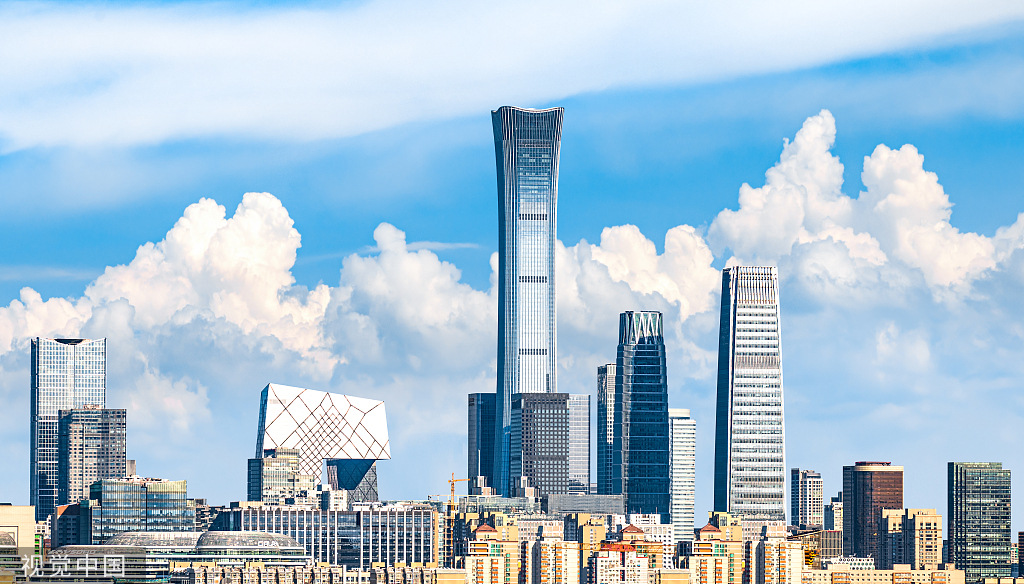
For a country with a population of over 1.4 billion, more than the population of all developed countries combined, it was never going to be easy to realize modernization.
Perhaps that's why when former leader Deng Xiaoping proposed that China strive to realize Chinese modernization in the late 1970s, no one imagined what China's modernization would look like 40 years later. And when Joseph Stiglitz, economics Nobel Prize winner, predicted that urbanization in China would be one of the most influential global events shaping the 21st century, some Western observers ignored it.
Modernization refers to progressive transition from a "pre-modern" or "traditional" to a "modern" society. In today's world, modernization comprises industrialization, urbanization and globalization. And China, as the second-largest economy with GDP of close to $18 trillion, has not only eradicated absolute poverty and built a moderately prosperous society in all respects, but is also striving to realize the second centenary goal of building a modern socialist country.
At the opening session of the 20th National Congress of the Communist Party of China on Oct 16, Xi Jinping, general secretary of the CPC Central Committee, explained the road map for building a strong modern socialist country by the middle of this century, emphasizing that improving people's lives is the very basis of this endeavor.
A modern society is characterized by advanced industry and technology and a high degree of urbanization, which propel economic development. Although not a widely accepted concept in the Western world, society building is imperative for modernization in China, which includes improving people's livelihoods and maintaining social stability. Three features of Chinese modernization are closely related to society building, and they are a large population, common prosperity, and material and cultural-ethical advancement.
The past decade has seen China making remarkable achievements in society building including eradicating absolute poverty, developing a moderately prosperous society in all respects, and largely containing the COVID-19 pandemic.
Also, China has realized sustainable economic growth, with a stable society further boosting development. These "two miracles" prove wrong Western political scientists such as Samuel Huntington who argue that modernity means stability while the modernization process creates turmoil.
How the miracles came about and how can they make the modernization process smooth?
In Western democracy, a political party acts as a link between civil society and the state; it stands for and protects certain vested interests and groups, and mobilizes resources to contest elections. In China the situation is different, as the CPC's policies are deeply rooted in Chinese society and aimed at benefiting all the people. The Party plays the leading role in governance and, avoiding partisan strife or interests, can implement long-term policies and strategies. In recent years, in particular, social policies have helped create more jobs, and improved healthcare and housing despite rapid urbanization.
How to balance the economy and society has been a major concern for most governments since the Industrial Revolution. It is still the key concern of modern states. Karl Marx said capitalism brings inequality which eventually engulfs the entire society. Karl Polanyi held a similar view, saying the "double movement" was the cause of Western economies' collapse in the 1930s.
As for welfare states, they believe the movement of labor eases tensions between capital and the working class, but they have encountered many challenges including rapidly aging societies, which require huge investments to ensure the well-being of all the people. Therefore, such welfare is hardly sustainable in the long run.
"Developmental states" such as Japan and the Republic of Korea took another path to development. These countries with strong state tradition tried to balance growth and stability when their economies took off. However, due to the Asian financial crisis in the late 1990s, the social welfare systems in these countries started malfunctioning. As a result, many adopted an inclusive welfare system as a remedy after the crisis.
Modern society faces many risks and uncertainties, which can be overcome only through joint efforts. And given the different perceptions of equity, justice and order, society building cannot be measured using economic indexes.
China's rapid development also faces different kinds of risks and challenges. That's why the Party encourages all stakeholders to work together to address serious problems including improving healthcare, public safety and community development. In fact, a community of social governance is critical to society building, and better collaboration leads to better performance in social sectors.
A more harmonious society will definitely help develop China into a great modern socialist country by the middle of this century, which is the country's second centenary goal.
To build a harmonious society, however, some basic principles need to be followed.
To begin with, society as a whole should follow the Party's leadership and advance socialism with Chinese characteristics. We should also realize that high-quality development and whole-process people's democracy will not only help China realize the second centenary goal, but also provide economic and political support to fulfill the task. And we must always keep in mind that common prosperity is one of China's ultimate policy goals.
The author is a professor conducting social governance research at China National Academy of Governance. The views don't necessarily reflect those of China Daily.
If you have a specific expertise, or would like to share your thought about our stories, then send us your writings at opinion@chinadaily.com.cn, and comment@chinadaily.com.cn.