


Framing a portrait of innovation










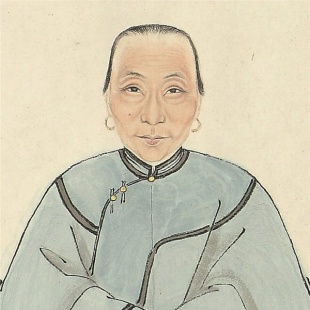
He first used light ink both to outline the subject's facial features and to shade certain areas of his face. This was before colored ink, sometimes of a rosy-beige or dusky tone, was applied on the face, one ultrathin layer after another. The goal was not to cover the black ink-shaded areas but to slightly subdue and soften them.
Still visible under the translucent colored paint, these inky parts would add dimension to a face that would otherwise look much flatter, emphasizing details from the brow ridge and cheekbones to wrinkles and eye bags.
"By doing so, Zeng had merged the two main methods in traditional Chinese portraiture, one using pure lines without any color or wash, the other, more popular in Nanjing and the surrounding regions, relied on the smooth application of colored ink for facial depiction," says Yang Zewen, the curator.
"He did so, informed by Western portraiture. And what he had accomplished was highly evocative representations of his subjects that still exuded the sensibilities of the literati culture."
To walk that fine line, Zeng had to adhere to a muted color palette, and had limited his experiments only to the faces of his subjects. The rest of the figure, clothing included, are rendered with highly suggestive lines.
The resulting succinctness and two-dimensionality was an antithesis to what his Western counterparts were so bent on achieving through their palpable rendition of delicate crispy lacework or sensual silk and velvet.
"Toward the end of the Ming Dynasty, the Yangtze River Delta region, where Nanjing was located, experienced great prosperity, which in turn led to a general enthusiasm toward anything new. Zeng, with his latest adaptations, became the portraitist of his time," says Yang Danxia.
"He was admired, copied and emulated as a pioneering force who brought the art to a place it had never quite been."
In 1644, three years before Zeng's death, the Ming Dynasty met its own end, succeeded by Qing, which lasted for another 267 years.
The dynastic transition did almost nothing to stop Western artists from coming to China, and Beijing in particular, where they tried very hard to impress the Qing rulers, and in that process, interacted closely with their Chinese counterparts.
Reflecting on Zeng's phenomenal success, Yang Danxia says: "It's important to remember that Zeng had never sought to revolutionize classical Chinese portraiture. In fact, his very success lies with the great sensitivity he had shown toward an art tradition into which he was born, while trying to take that tradition just one calculated step further."