Bridge or battleground
AI represents a crucial opportunity for China and the EU to work together to drive innovation that benefits people









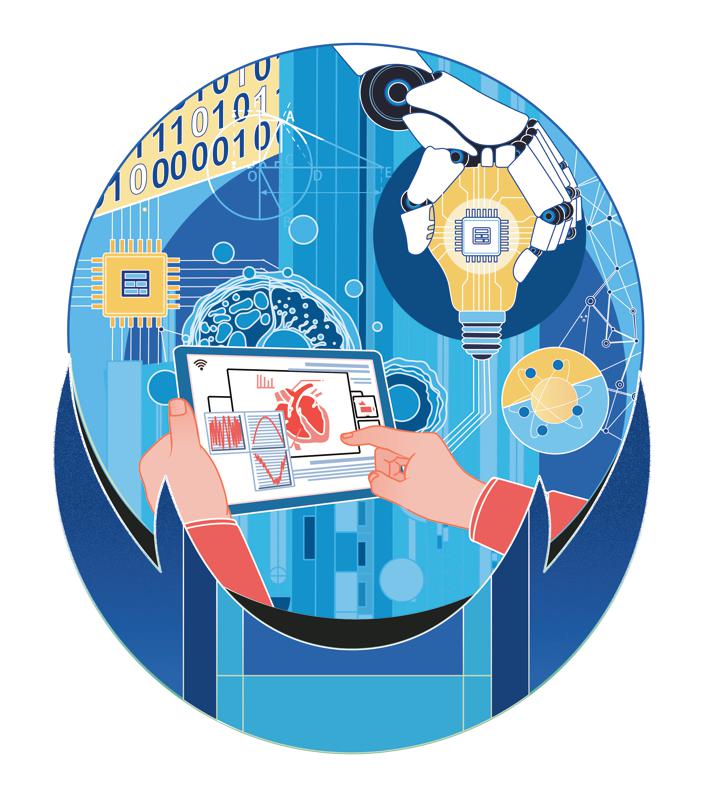
As the European Union and China mark the 50th anniversary of diplomatic relations, their relationship is being reshaped by both technological transformation and shifting geopolitical realities. Once defined primarily by trade and investment, this partnership now stands at the threshold of a new era — one where digital innovation, particularly artificial intelligence, could either become a bridge for cooperation or a battleground for competition.
With the rapid advancement of AI-driven industries, the EU and China have a clear opportunity to forge a partnership that benefits both sides. But whether this potential will be realized depends on how both parties navigate growing regulatory divides, geopolitical tensions, and economic uncertainties. As the global balance of power shifts, digital technology is emerging as a critical test of the EU's ability to engage with China on its own terms, rather than simply reacting to external pressure — particularly that from the United States.
For decades, EU-China relations have been shaped in part by the broader transatlantic alliance, with Europe often calibrating its China policy in response to Washington's approach. However, recent geopolitical shifts are challenging this dynamic. During Donald Trump's second term, the US has begun embracing a more inward-looking foreign policy, reducing its engagement with international institutions and partnerships that once shaped global trade and diplomacy. This retreat compels Europe to face a critical question: Should it follow Washington's lead in treating China primarily as a geopolitical rival, or should it develop a more independent, pragmatic strategy that balances competition with cooperation?
Some European leaders have argued for the latter, pushing for an EU policy on China that prioritizes European interests over alignment with US concerns. This recalibration is taking place at a time when China itself is expanding its influence, particularly in digital technology and infrastructure. The AI race has become a defining aspect of global power competition, and China has emerged as a formidable leader. Its investments in AI research, coupled with its ability to implement large-scale digital projects, have positioned it at the cutting edge of global technological development. From smart cities to AI-driven healthcare, China is not just catching up with the West — it is, in some areas, pulling ahead.
Much of the recent discourse around AI has revolved around economic competition and security risks. But lost in this conversation is the fact that AI is also one of the most powerful tools for improving lives. If Europe and China focus only on competition, they will miss a crucial opportunity to drive innovation that benefits people, rather than just markets.
In healthcare, China has made remarkable advances in AI-driven diagnostics, drug discovery and personalized medicine. Meanwhile, Europe leads in medical research ethics, regulatory oversight, and public healthcare systems. A structured initiative to develop AI-driven healthcare solutions — merging China's technological speed with Europe's focus on safety and patient rights — could revolutionize early disease detection, making lifesaving treatments more accessible and affordable.
Similarly, AI has the potential to accelerate climate action. Both China and the EU have committed to ambitious carbon reduction targets, and AI-powered solutions could be instrumental in optimizing renewable energy production, improving grid efficiency, and reducing industrial emissions. China's expertise in AI-driven smart cities — where machine learning enhances energy efficiency, reduces congestion, and cuts pollution — could be adapted to European urban centers struggling with sustainability challenges.
And in education, AI could play a critical role in bridging learning gaps. China has already implemented AI-assisted learning platforms that personalize education for students in remote and underserved regions. If combined with Europe's strong policies on digital inclusion and ethical AI deployment, these technologies could ensure that AI-powered education tools serve as a bridge to knowledge rather than a barrier controlled by a handful of dominant players.
Of course, cooperation does not mean ignoring security concerns. Europe has valid reasons to scrutinize AI governance, from data privacy to the risks of deepfakes and disinformation. The EU's AI Act, which establishes clear guidelines on transparency and accountability, offers a model for responsible AI governance that could be integrated into global discussions on digital ethics.
However, outright decoupling from China's AI ecosystem would not only be impractical but also self-defeating. Europe benefits from China's rapid pace of AI development, just as China benefits from Europe's regulatory expertise. The challenge is not whether to engage, but how to do so in a way that ensures fair competition, protects security interests, and maximizes the benefits for society.
A structured EU-China digital dialogue focused on practical cooperation — such as AI in healthcare, sustainability, and education — could be the foundation of a new era in technological diplomacy. Such an approach would allow both sides to collaborate where their interests align while maintaining safeguards where needed.
The AI revolution is unfolding at an unprecedented pace. The question is whether Europe and China will embrace the possibilities it offers for bettering lives, or whether they will allow mistrust and political posturing to stifle the opportunities at hand.
A world in which digital technology is used solely as a geopolitical weapon is a world that fails to unlock its true potential. But a world in which AI is harnessed for human progress, where innovation is channeled into solving real-world problems, can set the stage for a smarter, more sustainable future. Europe and China have a choice: They can let fear and rivalry dictate their digital policies, or they can engage constructively, focusing on the areas where cooperation makes sense. The best way forward is not isolation, but partnership; one that puts people at the center of technological progress.

The author is chairman of the board of the German Federal Association for Economic Development and Foreign Trade and chairman of China Bridge, a public diplomacy forum for more constructive engagement with China based in Berlin. The author contributed this article to China Watch, a think tank powered by China Daily. The views don't necessarily reflect those of China Daily.
Contact the editor at editor@chinawatch.cn.