Visit to boost neighbors' ties amid tariff war










Chinese President Xi Jinping's visit to Vietnam, Malaysia and Cambodia from Monday to Friday is expected to deepen relations between China and not only the three Southeast Asian countries but also the Association of Southeast Asian Nations as a whole.
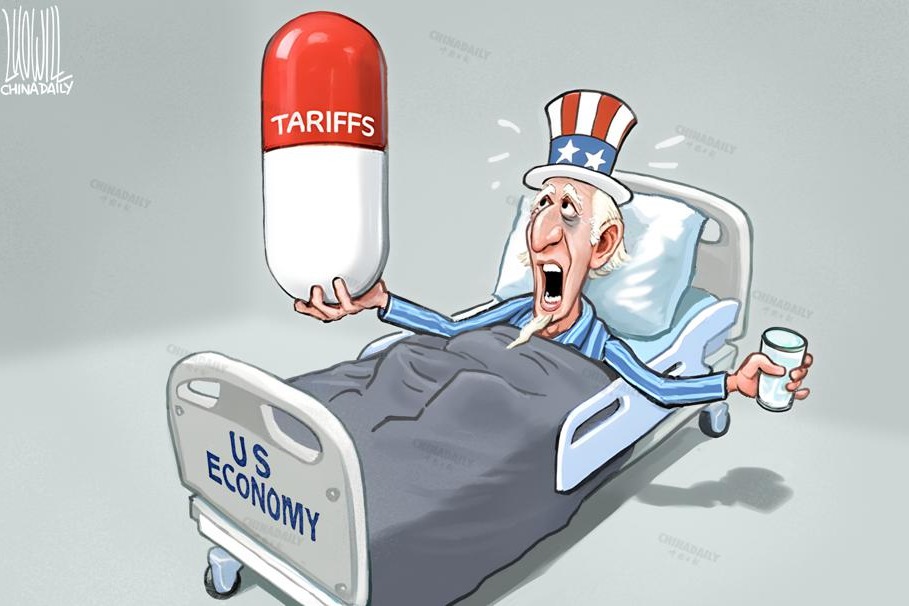
President Xi's visit to the three countries comes at a time when the US administration has launched a tariff war against China, and Washington's other trading partners. The US has adopted a highly protectionist trade policy, triggering trade conflicts and causing uncertainties for the global economy. Indeed, the rise of protectionism has fractured supply chains and diminished trust among nations.
Under such circumstances, ASEAN has become even more crucial for China's strategy — as a trade partner, investment destination and neighbourhood economy. As such, his visit is not only timely but could also create more opportunities to deepen China-ASEAN cooperation.
To defuse the economic tensions triggered by the extraordinarily high US tariffs, a major economy like China should take measures to help expedite regional economic recovery and maintain regional stability. By doing so, China can turn the crisis into an opportunity, positioning itself as a reliable partner of ASEAN. And by combining concrete economic support with trust-building diplomacy, China and ASEAN can forge a united front against US protectionism while building a multipolar global economy.
To strengthen regional trade resilience, China and ASEAN should expeditiously implement the existing free trade agreements — the ASEAN-China Free Trade Agreement and the Regional Comprehensive Economic Partnership — eliminate tariffs on ASEAN's export-oriented goods such as electronics, textiles and farm products which have been hit hard by the US tariffs, simplify the rules of origin and smooth customs procedure for ASEAN goods at Chinese ports.
China should also accord priority to ASEAN farm and aqua products, and consumer goods, and make the process of entering the Chinese market easier for some ASEAN exports. Equally important, since both China and ASEAN uphold the multilateral trading system, they could consider filing a joint case with the World Trade Organization against the US' tariffs.
As for the market diversification strategy, China and ASEAN should jointly promote ASEAN and Chinese export-oriented goods such as halal food, and renewable and green products through, for example, trade fairs in Africa, the Middle East and Latin America, and leverage the Belt and Road Initiative to access new markets in the Global South.
Additionally, China should create more economic opportunities for ASEAN member states to redirect their exports to China and third-party countries via Chinese e-commerce platforms such as Alibaba and Pinduoduo.
To diversify the global supply chains, China should explore the possibility of relocating the manufacturing units of tariff-targeted goods to ASEAN member states not only to avoid US tariffs but also to create more jobs for the local people and share advanced technologies for high-value industries, such as electric vehicle battery plants in Indonesia and semiconductor test labs in Thailand.
Also, Chinese investors should collaborate with local entrepreneurs, including small and medium-sized enterprises, in ASEAN to jointly develop innovative products and share their intellectual property rights, and Chinese companies should "teach" local SMEs how to use Chinese e-commerce platforms in order to help them expand the reach of their products to broader global markets.
In particular, Chinese enterprises should demonstrate that their ventures in ASEAN member states are mutually beneficial by ensuring, say, 70 percent, of their workers are local people, while the Chinese government could consider providing some financial assistance, such as funding grants, for ASEAN start-ups in green technology and the digital economy.
To help some financially weak ASEAN members cope with the global shocks, China and ASEAN should explore the possibility of setting up regional financial funds, including an emergency economic stabilization fund, to stabilize currencies and to help countries emerge out of balance-of-payment crises.
And to build financial safety nets, China and ASEAN should expand their local currency settlement mechanism by broadening the scope of the Chinese yuan-Singapore dollar, yuan-Thai baht or yuan-Indonesian rupiah currency swap agreements.
In sum, President Xi's visit to the three countries is likely to boost regional trade and investment, and pave the way for China to lead the region's economic recovery and maintain economic stability amid the intensifying US tariff war. The visit will also help China take actions to demonstrate that ASEAN is a reliable and mutually beneficial trading partner.

The author is an associate professor in the Faculty of Economics, Thammasat University, Thailand. The views don't necessarily reflect those of China Daily.
If you have a specific expertise, or would like to share your thought about our stories, then send us your writings at opinion@chinadaily.com.cn, and comment@chinadaily.com.cn.