Screen sensation acts as blockbuster bridge between India and China










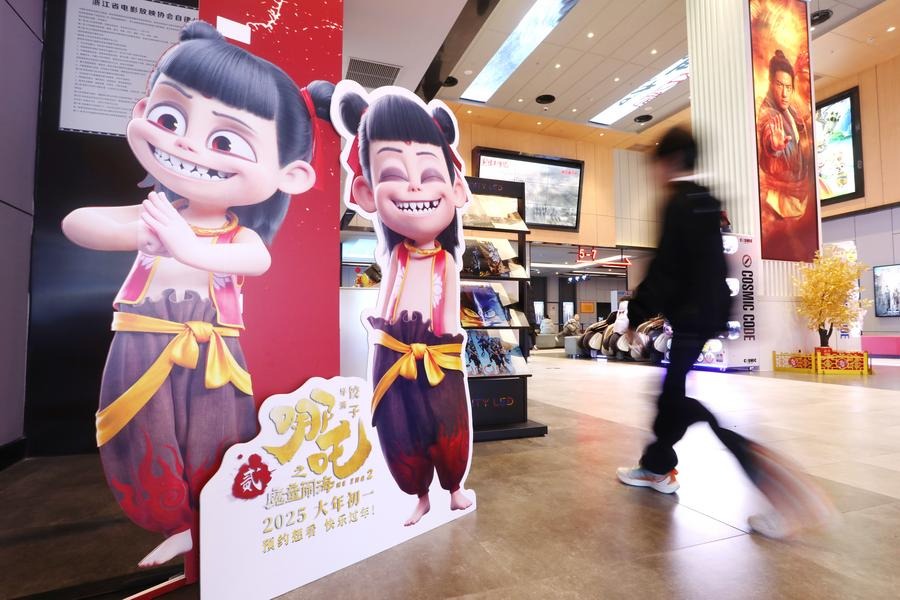
The Chinese animated blockbuster Ne Zha 2, that opened in Indian theaters on April 25, offers more than just stunning visuals and recordbreaking numbers — it also provides a rare opportunity to deepen cultural understanding and foster people-to-people ties between India and China.
With a global box office gross surpassing $2.1 billion, Ne Zha 2 is already the highest-grossing animated film in history. Now, its Indian debut carries a deeper ambition: to spark meaningful cultural connection.
The film's release comes at a significant moment in India-China relations, as this month the two neighbors commemorate the 75th anniversary of the establishment of diplomatic ties. While official exchanges dominate the headlines, it is through stories, shared symbols, and cultural memory that people truly connect. And Ne Zha 2, with its Indian mythological roots and Chinese storytelling, stands as a remarkable cinematic bridge.
At the heart of Ne Zha 2 lies a character that Indian audiences may recognize more than they realize. Nezha, the fiery child-god born from a lotus, is not merely a Chinese creation. According to professor Meir Shahar, a leading Israeli scholar of Chinese religion, literature and culture, Nezha's origins can be traced back to Nalakubara, a divine figure in Hindu and Buddhist lore.
In his book Oedipal God: The Chinese Nezha and His Indian Origins, Shahar presents compelling evidence of Nezha's journey from the Sanskrit epics to the Chinese imagination.
This deep cultural linkage — transmitted through Buddhist sutras, translated and adapted over centuries — illustrates how ancient India's religious and mythological ideas contributed to shaping key figures in Chinese folklore. In the case of Nezha, the character's evolution from Nalakubara, the son of Kubera (the Hindu god of wealth), into a Taoist rebel deity underscores the organic and lasting nature of these cross-cultural transmissions.
For Indian audiences steeped in stories of Krishna, Rama, and Arjuna, the themes in Ne Zha 2 — rebellion, sacrifice, divine birth, and cosmic justice — will feel strikingly familiar.
The emotional core of Ne Zha 2 is built on themes of identity, self-determination and redemption — values cherished in both Indian and Chinese cultures. At a time when global narratives often focus on rivalry and difference, the film offers a refreshing reminder of how much the two civilizations share. It's not just about dragons or deities, but about familial duty, moral courage, and transformation — stories that transcend borders.
In a media landscape often saturated by Western superheroes and Hollywood tropes, Ne Zha 2 presents a compelling alternative rooted in Asian storytelling. The film's success in China and beyond proves its global appeal — but it's in India, with its love of mythical epics and visual spectacle, that Ne Zha 2 could find one of its most appreciative audiences.
India's cinematic ecosystem has long embraced visually ambitious narratives, films such as Baahubali, RRR, and Brahmastra are testaments to the enduring appeal of myth-meets-modernity storytelling. Ne Zha 2, with its around 2,000 special effects shots crafted by over 4,000 artists, stands comfortably in that lineage.
More than a box-office event, the release of Ne Zha 2 can be seen as a soft-power milestone — an invitation for deeper cultural exchange through popular media. While political relations may wax and wane, cultural affinity often provides steady ground. Films such as Ne Zha 2 can help humanize and demystify the "other", opening windows into each other's worlds for Indian and Chinese audiences alike.
It's also an opportunity for Indian viewers — particularly young audiences — to engage with Chinese culture beyond the news headlines. Through Nezha's story, viewers can explore a character who straddles both Indian and Chinese legacies. This act of shared storytelling can lay the groundwork for greater curiosity, mutual respect and people-to-people engagement.
The author is a senior Indian journalist and international affairs analyst, with a special focus on history, cultural exchange, and civilizational dialogue. The views don't necessarily reflect those of China Daily.
If you have a specific expertise, or would like to share your thought about our stories, then send us your writings at opinion@chinadaily.com.cn, and comment@chinadaily.com.cn.