Middle East tensions nearing climax









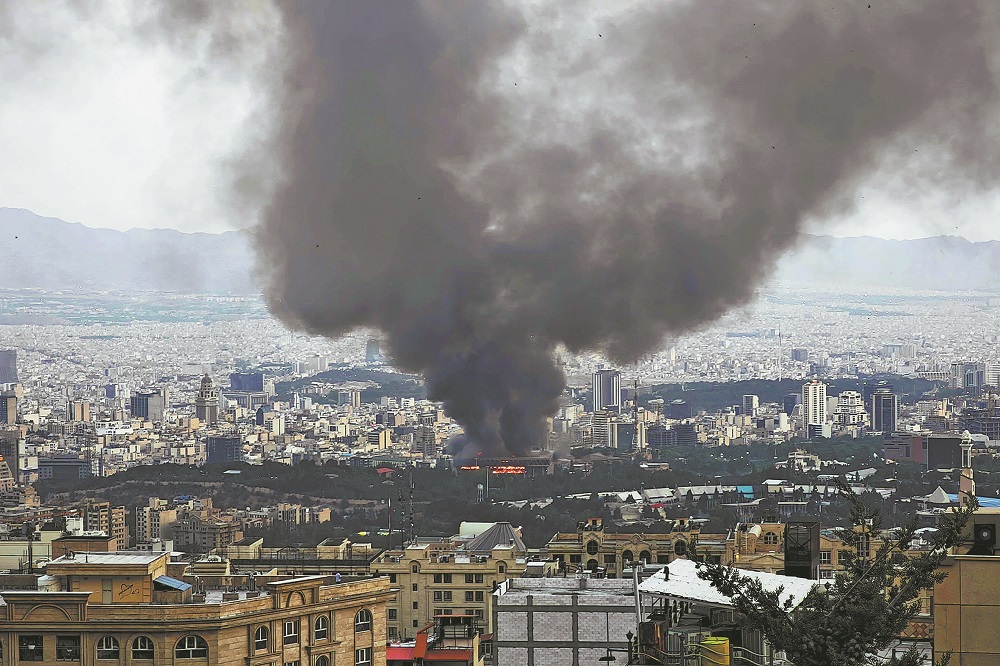
Editor's note: The world is holding its breath as the conflict between Israel and Iran rages. Experts share with China Daily the strategic issues behind the conflict, its broader impact on the world, including on oil prices and the global economy, and the role of the United States. Excerpts follow.
The Middle East walks a tightrope
By Ma Xiaolin
The escalating conflict between Israel and Iran has pushed the Middle East into one of its tensest moments. What began as a series of assassinations, sabotage, and cyberattacks has now erupted into an open conflict, with both sides seemingly prepared to go the distance. The international community watches nervously as the situation threatens to spiral out of control, destabilizing not only the regional but also the global economy.
For years, Israeli intelligence operations have been trying to penetrate into Iranian territory. From the targeted killings of nuclear scientists to the bombing of sensitive facilities, Israel's capability in covert warfare is almost unmatched. In contrast, Iran's counterintelligence mechanism has shown to be porous. Even top Iranian Revolutionary Guard Corps-protected sites have been infiltrated, leading to high-profile assassinations.
Israel seems determined to cripple Iran's long-range strike capability, dismantle its intelligence network, and thwart its nuclear plan — if not permanently, then for the foreseeable future. For Teheran, the repeated violations of its sovereignty have made retaliation inevitable. To stay silent would mean accepting not just a military setback, but national humiliation.
Iran has been dealt a body blow so to speak, with its senior commanders eliminated one after another, and the skies over Teheran perforated with Israeli missiles. Israeli jets, emboldened by their operational freedom, have reportedly circled the capital several times — even refueling mid-air — without challenge. Israel, it seems, is out to prove its tactical superiority.
However, Iran's recent counterstrikes, unprecedented in scale, have hit major Israeli cities and even defense installations, shattering the long-held belief of Israel's invulnerability and proving the conflict is no longer one-sided. Yet the growing tit-for-tat is dangerous, with neither side showing signs of de-escalation.
Iran is a regional heavyweight in terms of population and geography, while Israel enjoys technological superiority and the backing of the United States. But geography has complicated Iran's strategy — distant from Israel by more than 1,000 kilometers, Iran cannot fully leverage its demographic or resource advantages, while US support continues to flow into Israel in the form of intelligence, weapons and high-tech military equipment.
The US' dubious role in the conflict is difficult to ignore. While publicly engaging with Teheran in multiple rounds of talks, Washington has seemingly been coordinating with Tel Aviv behind the scenes, thus encouraging it to attack Iran. The US-Iran talks in hindsight appear to be a strategic feint — one that may have prompted Teheran to lower its guard while Tel Aviv prepared to attack Iran. With political pressure mounting, the open involvement of the US in the conflict cannot be ruled out, especially if Israel struggles to achieve its objectives quickly.
However, a prolonged war would benefit no side. Oil prices are already soaring, threatening to disrupt global supply chains and derailing fragile economies' recovery. To prevent the Persian Gulf, through which the world's energy arteries pass, from being turned into bloody battlefield, the international community has been urging the warring sides to exercise restraint.
Arab states, however, are walking a tightrope — careful to avoid being drawn into the conflict. In fact, some oil-rich countries may benefit from higher oil prices, provided shipping lanes remain open. But if Iran broadens its response by, say, targeting US bases in the Gulf or activating proxy forces like the Houthis or Iraqi militias, the conflict could easily spread across borders.
But history warns us against underestimating Iranian nationalism. A country that has encountered centuries of foreign invasion without yielding easily should not be considered weak or extremely vulnerable. This raises the fear that the conflict could turn into widespread regional conflict, drawing in global powers. As such, the international community should act urgently to de-escalate the situation before the window of diplomacy closes.
Ma Xiaolin, dean of the Institute for Studies on the Mediterranean Rim at Zhejiang International Studies University. The views don't necessarily represent those of China Daily.