Broad perspective necessary to understand China









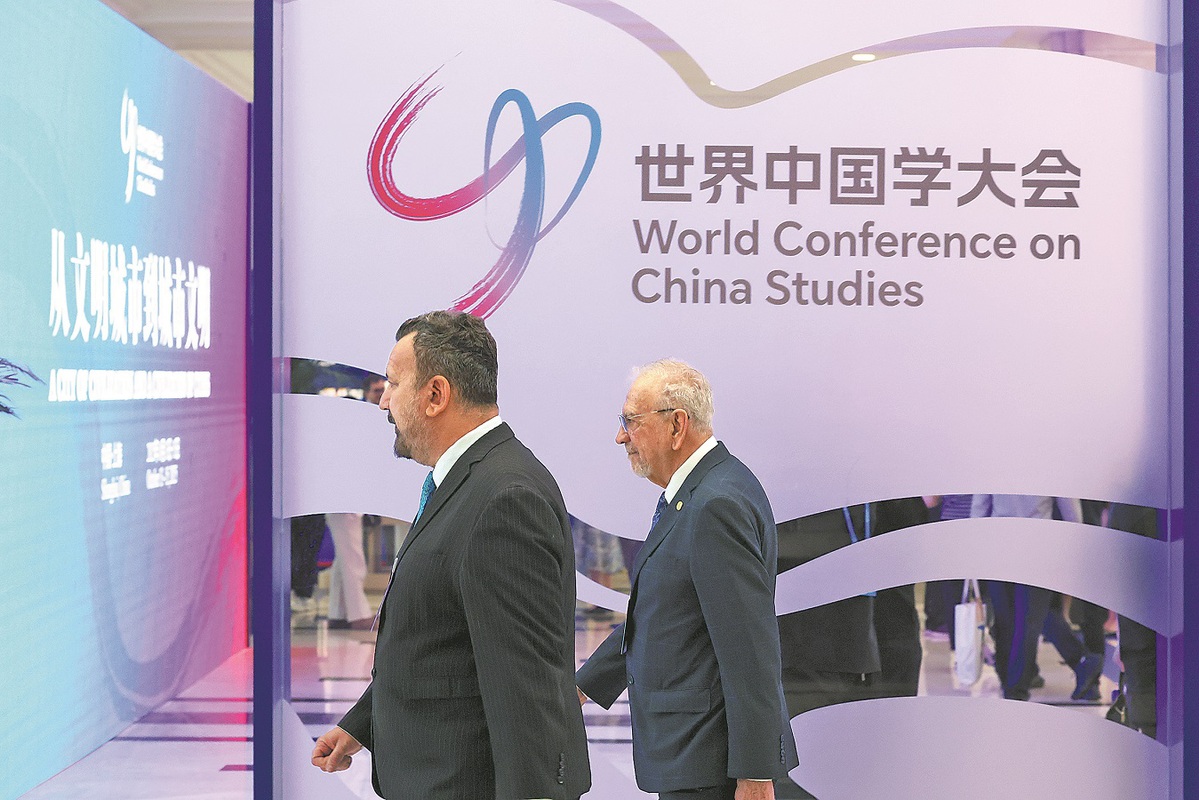
Editor's note: The second World Conference on China Studies, held in Shanghai from Monday to Wednesday, aimed to foster a broad consensus on advancing Sinology and encourage cultural exchanges between China and the global community. Lin Shangli, president of the Renmin University of China, delivered a speech during the conference. Below are excerpts from his speech reported by the news portal Guancha.cn. The views don't necessarily represent those of China Daily.
As a scholar of political studies, I face significant challenges when explaining China's political system to scholars worldwide. The key to resolving this dilemma is to deeply engage with China's context. Only by returning to China's context can we truly understand how the country has arrived at where it is today, as well as the underlying logic and future trajectory of its structure and organization.
China's context is constructed in three dimensions. The first dimension is time, often referred to as China's 5,000-year civilizational history. This 5,000-year civilization has shaped China's unique history, society, culture and spiritual essence. However, there are many questions yet to be addressed. What does it mean for such a large country to have maintained an uninterrupted civilization for 5,000 years? What is the soul and genetic makeup of Chinese culture?
China's 5,000-year civilization has undergone a transformation from ancient to modern times, a process other countries have also experienced. However, the transformation of every civilization is distinct, and the historical framework used to explain the transition from ancient to modern civilizations in the West cannot be applied to China's modern development. To understand this better, we must return to China's context. The 5,000 years of Chinese civilization have created the underlying logic and structure of China, which requires systematic and in-depth study. Therefore, exploring China's context has become crucial in China studies.
The second dimension is a geographic space. China is a super-large society, which brings unique advantages but also presents challenges that smaller and medium-sized countries do not face. It also features unique structural characteristics, such as the "plurality and unity" of its social structure, the "central and local" structure of its State, the "democracy and centralization" of its political structure, the "government and market" structure of its economy, the "local and overall" structure of its development and the "State and society" structure of its governance.
Western theories are based on the experiences of smaller societies and cannot be directly applied to understand China's issues. China has been able to maintain harmony, order and sustainable development due to the profound logic within its various structures. This logic is difficult to explain with existing theories, and scholars need to explore it anew. Such an endeavor will be valuable not only for understanding China but also for opening up new research fields.
The third dimension is the Chinese system. Socialism with Chinese characteristics is the product of the integration of Marxism with China's fine traditions, human civilization achievements and the country's practical exploration.
For China, socialism is not only a social system but also a way of life, a development model and a civilizational system. Through this system, China has achieved modernization and effective governance, allowing its people to live happily. Socialism not only opened up a new path but also created a new form of civilization.
To understand China today, we must delve deeper into these three dimensions. Only by adopting a broader vision, a wider perspective and a more professional attitude can we truly understand the country. China studies will undoubtedly contribute new insights to the world about China's development.