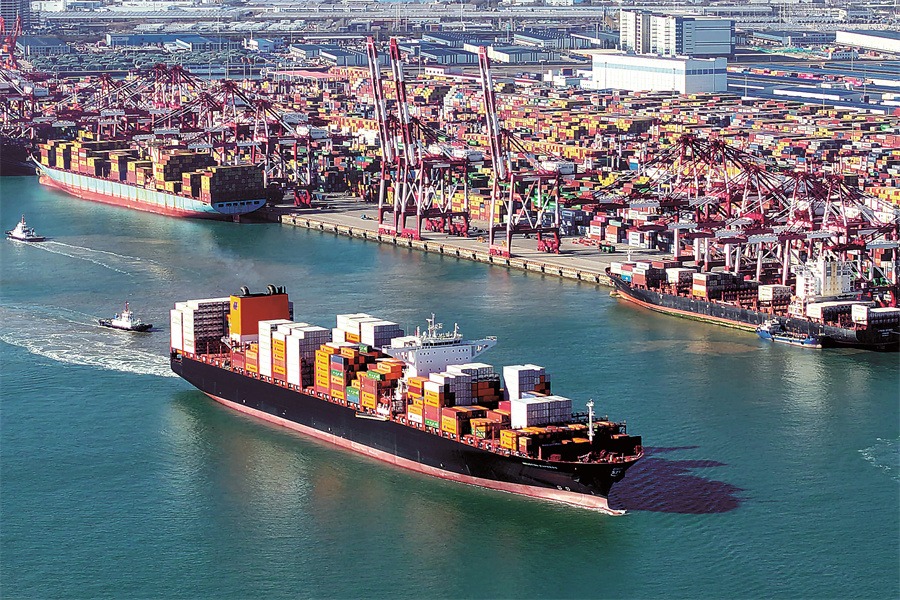
China brings stability to global growth











The United States' persistent campaign against Chinese private enterprises, especially in high-tech sectors, has drawn international attention for its extreme measures. Executive orders have restricted cooperation with key Chinese companies, and their access to critical technologies has been blocked. The US has taken steps to cut off Chinese firms from essential semiconductor supplies, while imposing restrictions on their access to global software and platforms. Moreover, the US administration has even amended domestic laws to prevent Chinese companies from accessing US technologies and markets.
Such steps are part of the US' broader strategy to curb China's rise and confine it to the lower and middle tiers of global innovation and value chains. Washington is trying to build global anti-China tech alliances that would create a "digital iron curtain" to suppress China's advances in 5G and artificial intelligence.
In the face of such hegemonic containment, China must rely on its own capacity and ingenuity for technological advancement. But development must be grounded in security. This is why China is following a strategy to balance development and security, strengthen bottom-line thinking and build a new security architecture that effectively prevents and defuses risks.
China understands the importance of development and security. Following the Opium War of 1840, the country was unable to protect its national sovereignty. This period brought profound suffering to the Chinese people and marked a deep national crisis. Since then, China has forged a distinctive approach to national security.
National development is a complex undertaking that requires balancing pace with protection. Just like a high-speed train requires stronger and more sophisticated tracks to avoid disaster, so too must advances in fields like artificial intelligence be guided by ethical guardrails to prevent harm to humanity. Similarly, excessive financial leverage may promise short-term gains but risks systemic collapse.
Nor does China treat security as an end in itself. The ultimate goal is the safety and well-being of the people. When China safeguards 1.8 billion mu of farmland, it is to ensure food security for 1.4 billion Chinese people. When it strengthens energy security or improves data protection systems, it is to maintain the basic living standards and protect both critical infrastructure and personal information.
China's path is not one of zero-sum competition. Concepts such as "win-win cooperation" and "harmony as priority" are embedded in Chinese culture for millennia and continue to guide China's national security strategy. At the 2013 G20 Summit, President Xi Jinping advocated that nations need to build a community with a shared future for humanity, recognize interconnected interests, cooperate amid competition, and pursue win-win outcomes.
The current global landscape is marked by geopolitical risks and an unstable environment for development. Unilateralism and protectionism are on the rise, and hegemony is rampant in international trade and the global economy. The arbitrary tariffs imposed by the US have weakened global economic growth.
All these factors have introduced considerable uncertainty into the world economy. Against this backdrop, China's new security architecture is a timely response to the global need for steady and forward-looking development.
The new security framework also promises a more peaceful and stable international environment. Since the dawn of the modern era, Western powers have often used military force to expand their influence and pursue global dominance. China fell behind in economic and technological development because it was unable to safeguard its interests. The Opium War resulted in the country being forced to cede territory and pay massive war indemnities.
Learning from this painful history, China values a peaceful external environment for its development and does not wish to see any nation or its people suffer from the tragedies of war, famine and family separation. To realize this vision, the Chinese people have worked diligently to strengthen economic growth and enhance technological capacity. Now, China is able to not only protect its own interests, but also help reduce global conflicts to foster peace worldwide.
China's new development path has created opportunities for global progress and prosperity. China has undoubtedly benefited from economic globalization. But it has also been a significant contributor, defender and promoter of the process. The country remains committed to steering economic globalization in the right direction and has played a key role in promoting the sustained and healthy growth of the world economy.
Since China's reform and opening-up, it has integrated deeply into the global economy, becoming a crucial engine of growth and a stabilizing force worldwide. China's contribution to global economic growth has consistently stood at around 30 percent. Whether it was the Asian financial crisis of the late 1990s or the 2008 international financial crisis, China helped stabilize the global economy when it mattered most.
China's new opening-up strategy champions cooperation and mutual benefit. It arrives in a world where many nations are grappling with domestic imbalances, even as the headwinds of unilateralism, protectionism and extremism are gaining ground.
In response, China has advanced institutional opening in a firm and systematic manner. Visa policies have been relaxed, rules have been aligned with international norms and sectors such as services, investment, talent and the digital economy have been further opened.
China is also steadily developing bilateral free trade agreements with partner countries under the Belt and Road Initiative and facilitating institutional opening-up in cross-border capital flows, thereby providing a sound framework for the efficient and orderly movement of capital.
Through this new pattern of open development, China aims to break down the barriers of anti-globalization, advance the reform of global governance and lend stability to the world's evolving development landscape.
By advancing a new development paradigm, China has struck a balance between development and security, offering both inspiration and practical pathways for resolving the current dilemmas in global development.
The author is a professor and deputy head of University of International Relations. The views don't necessarily reflect those of China Daily.
If you have a specific expertise, or would like to share your thought about our stories, then send us your writings at opinion@chinadaily.com.cn, and comment@chinadaily.com.cn.