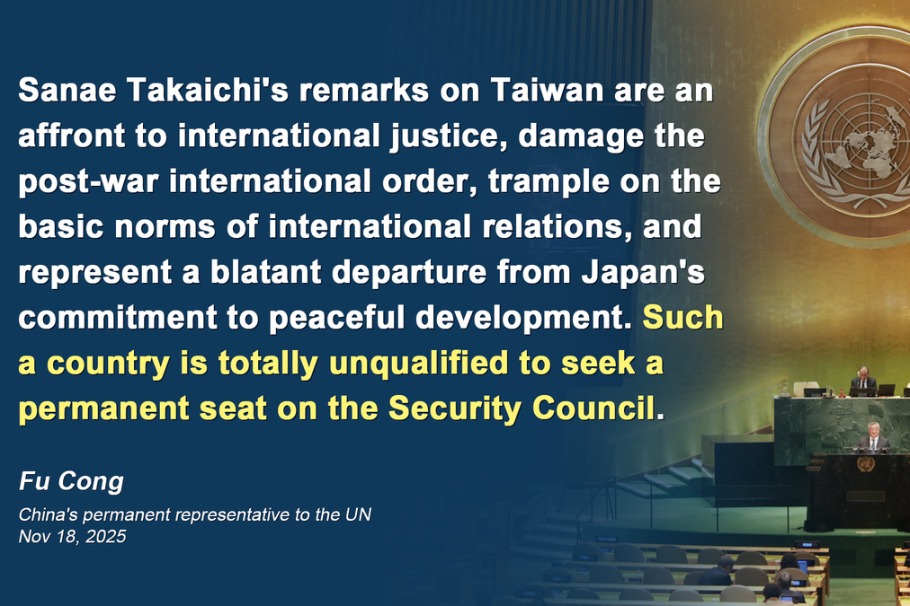
Takaichi's provocative remarks run afoul of law










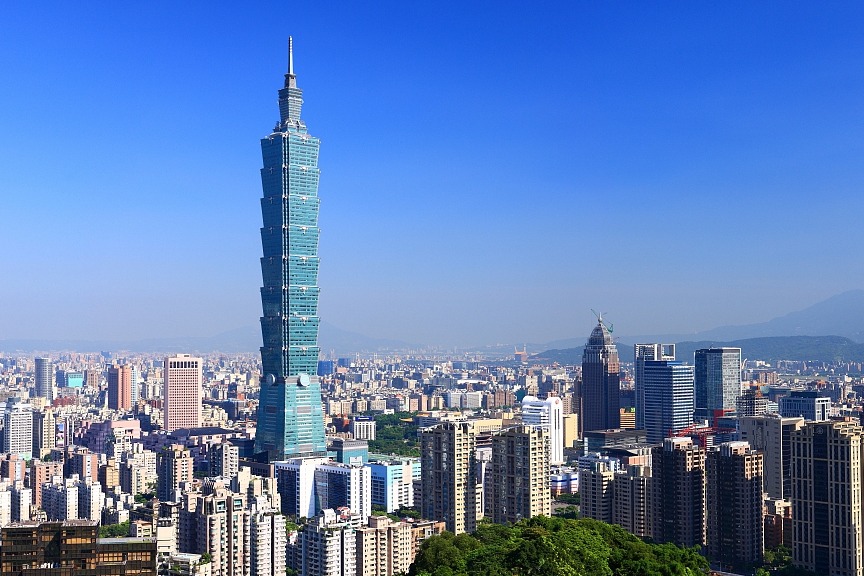
Taiwan has been a part of China since ancient times. The earliest clear record of Taiwan in Chinese history dates back over 1,700 years. The Chinese were the first to develop Taiwan and implement effective governance over it, with Taiwan society consistently maintaining the traditions of Chinese culture. During the Yuan Dynasty, the central government officially established administrative institutions to govern Taiwan, and in the Qing Dynasty, Taiwan was formally made a province. In April 1895, following a war of aggression against China, Japan forced the Qing government to sign the unequal Treaty of Shimonoseki, seizing control of Taiwan.
During the half-century colonial rule, Japanese forces faced strong resistance and carried out a bloody suppression campaign that lasted months. Braving the pressure, Taiwan compatriots launched the Yiwei War, or the war in 1895, in which the Japanese military suffered about 40,000 casualties from both combat and diseases.
Many heroes emerged in the resistance, such as Qiu Fengjia, who organized a volunteer armed force that inflicted heavy losses on the Japanese army. In 1930, the indigenous Seediq people rose against Japanese oppression but their resistance was brutally suppressed.
After that, the Taiwan people continued their resistance through cultural means. Since the 1930s, Japan forced Taiwan residents to adopt Japanese names, receive Japanese cultural education, and learn the Japanese language. The island's people steadfastly resisted these measures. Many traveled to the Chinese mainland to join the resistance against Japanese aggression. After Japan's full-scale invasion of China in 1937, records show that over 50,000 Taiwan youth returned to the motherland to fight, thousands of them sacrificing their lives.
Among them was Li Youbang, a Taiwan patriot who later organized Taiwan volunteer corps in Jinhua, Zhejiang province, and established hospitals, while fighting alongside his mainland compatriots against Japanese aggression.
In 1945, Japan surrendered, leading to Taiwan's restoration to China. The Japanese Instrument of Surrender explicitly accepted the terms of the Potsdam Proclamation in July 1945, which mandated Japan's unconditional surrender. The proclamation emphasized the full implementation of the Cairo Declaration in 1943, which clearly stipulated that all the territories Japan had stolen from China, such as Northeast China, Taiwan and the Penghu Islands, should be restored to China. The Potsdam Proclamation defined Japan's postwar territory, while the Cairo Declaration stipulated that Taiwan and the Penghu Islands should be restored to China. Therefore, there is no legal room for misinterpretation regarding the Taiwan question.
The recent erroneous and provocative remarks made by Japanese Prime Minister Sanae Takaichi regarding Taiwan not only violate international law but also Japan's Constitution. First, the Japanese Instrument of Surrender stipulates that the Japanese emperor, government, and their successors must abide by the provisions of the Potsdam Proclamation. This means unless Japan renounces its surrender document, it remains bound by the Cairo Declaration and cannot invoke the "San Francisco Peace Treaty" — which China never recognized — to justify its claims about Taiwan. Clearly, there is no such thing as "undetermined status of Taiwan".
The 1972 China-Japan Joint Statement commits "The Government of the People's Republic of China reiterates that Taiwan is an inalienable part of the territory of the People's Republic of China. The Government of Japan fully understands and respects this stand of the Government of the People's Republic of China, and it firmly maintains its stand under Article 8 of the Potsdam Proclamation."
The 1978 Sino-Japanese Treaty of Peace and Friendship stipulates that bilateral relations be conducted in accordance with the UN Charter and the Five Principles of Peaceful Coexistence, settle all disputes by peaceful means and shall refrain from the use or threat of force. Ratified by Japan's Diet and China's National People's Congress, the treaty has made the joint statement's commitments legally binding.
Takaichi's remarks are therefore entirely illegal as they interfere in China's internal affairs, directly contravening Japan's legally binding commitments.
Her remarks also violate Japan's domestic laws. Article 9 of Japan's Constitution renounces the nation's right to engage in war or to resort to military force to resolve international conflicts. Additionally, Article 98 stipulates that the constitution is the supreme law of the nation and no law, ordinance, imperial rescript or other act of government, or part thereof, contrary to the provisions hereof shall have legal force or validity. The article further emphasizes that the treaties concluded by Japan and established laws of nations shall be faithfully observed. Takaichi's remarks breach the 1978 treaty it concluded with China, thereby contravening Article 98 of Japan's Constitution.
To rectify these wrongdoings, Takaichi must retract her remarks, unequivocally affirm Japan's commitment to the one-China principle, and apologize for the damage her provocations have caused to bilateral relations. Instead, the course she seems to be favoring — increasing military spending to hit the 2 percent of GDP ahead of schedule, enhancing so-called "counterstrike capabilities" for waging war, and considering the review of "Three Non-Nuclear Principles" — will only take Japan on a misguided course.
This is anything but "normal". Japan's so-called "normalization" is essentially an attempt to whitewash its wrongdoings and dangerous tendencies.
The author is a professor of international relations at Tsinghua University. This is an excerpt of his interview with China Daily's Li Huixian.
The views don't necessarily represent those of China Daily.
If you have a specific expertise, or would like to share your thought about our stories, then send us your writings at opinion@chinadaily.com.cn, and comment@chinadaily.com.cn.