Housewives spend more in 2011, mostly on travel and investment
Updated: 2012-02-24 09:21
By Wang Zhuoqiong (China Daily)
|
|||||||||


BEIJING - Chinese housewives, who traditionally hold the purse strings, spent more last year, with most of the increase going into trips and investments in stocks and real estate, a report has found.
|
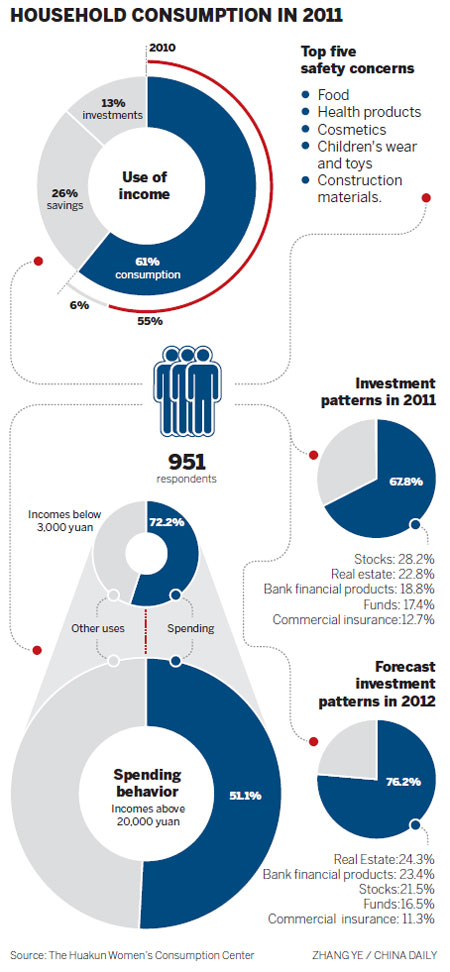 |
In 2011, more than 60 percent of the average household income went into consumption, six percentage points more than in 2010. Another 26 percent of income went into the bank, while 13 percent was invested in a variety of assets and financial products, said the report by the Huakun Women's Consumption Center, a unit of Women of China magazine.
The center conducted a survey - on household spending in 2011 and spending plans for 2012 - in October.
The survey covered 951 women aged 18 to 60 living in 10 cities including Beijing, Shanghai and Dalian. More than 80 percent of those interviewed were married.
The average monthly household income for these women was 15,933 yuan ($2,530). The women had individual incomes of 5,717 yuan on average.
Huo Jianguo, president of the Chinese Academy of International Trade and Economic Cooperation, a think tank of the Ministry of Commerce, said female spending had assumed a leading role in lifting domestic consumption.
Promoting domestic consumption is a government priority to spur economic growth as the export outlook dims amid slack demand from Europe and the US.
Wives made about 77 per cent of the household spending decisions in 2011, according to the center's research. China has more than 400 million households and 650 million women.
The higher a family's monthly income, the lower the proportion it spent, the survey found. Households with monthly incomes of less than 3,000 yuan spent about 70 percent of the money that came in, while the proportion was just 51.5 percent for households with monthly incomes exceeding 20,000 yuan.
Households spent 8,761 yuan a month on average, with nearly one-third directly spent by women.
Of the 10 cities covered in the survey, Guangzhou was first with average monthly spending of 14,690 yuan, followed by Chengdu and Changsha.
Travel became a fast-rising expense for households last year. Nearly 70 percent of the households surveyed traveled last year, spending 8,858 yuan on average - up 56.3 percent from 2010.
Those in Shanghai spent the most on travel, followed by Changsha and Dalian.
Jiang Fang, 31, a manufacturing entrepreneur, went to the United States with her husband and two friends last September. They visited Las Vegas, San Francisco and Los Angeles in a rental car. Each person spent about 15,000 yuan on the trip.
Jiang plans to visit the US East Coast this year.
Another big part of the average household budget is investment.
About seven out of 10 families invested in 2011, with Chengdu ranking first, followed by Guangzhou and Ningbo. The most popular investments were stocks, real estate, banking products, funds and commercial insurance.
But only 13.5 percent made a profit on their investment, 33.7 percent broke even and nearly 30 percent lost money.
Gold topped the list of profitable investments, followed by luxury goods, property, bonds and banking investment products.
Lin Lang, who owns a wedding gown studio in Beijing, bought banking investment products and commercial insurance last year. But neither yielded returns in excess of the inflation rate.
To her disappointment, the market value of one of her properties in Beijing's Central Business District fell below what she paid for it in 2010.
"Stocks are risky. Gold might be an option," she said. "But I guess the best investment is to avoid spending and make more money from our real business."
For women, clothing was the largest single category of personal spending each year, the survey showed, followed by housing.
The survey also showed that eight out of 10 women like online shopping and 32 percent often buy online.
Zhu Hong, 25, bought her whole winter wardrobe from shops on Taobao and other online retailers.
"It was too cold to venture outside in Beijing," Zhu said, "not to mention the rising cost of gasoline and parking. The online retailers delivered to my doorstep and I can return most of (the items) if I don't like them. Every time the door bell rings, it feels like Santa Claus is visiting."
For this year, women expect that clothing will again top their shopping list, followed by cosmetics, household appliances, real estate, mobile phones, electronic products and vehicles.
Related Stories
Investments in China continue to grow steadily 2011-03-16 11:01
Govt makes case for investing in the US 2010-12-28 10:53
Govt to invest $15 b in farmland 2010-12-20 07:59
Chinese companies to boost overseas investment 2011-04-28 07:14
- Search for oil, gas set for faster expansion
- 'Chance' to open capital account
- CSRC to curb irrational speculation
- Housewives spend more in 2011
- Michael Jordan sues Chinese company Qiaodan
- China sees $3.1b 'hot money' outflow in 2011
- China to raise health insurance subsidies
- Chinese movies have little int'l influence