Poetry with power
The Arabic poet is positive about the future of poems, believing poetry will never die as long as there is love, death and dreams.
"Technology can make it possible for people to wear the same clothes, drive the same cars and eat the same food, but it will never make people dream the same dream," he says.
Since 1988, Adonis has been a serial nominee for the Nobel Prize in Literature, but the elusive award has become something of a burden for Adonis — even in China he cannot avoid questions about the prize.
 |
|
Adonis' My Loneliness Is a Garden and Writing on the Horizon of Meaning are published in Chinese. |
"I totally agree that if the next Nobel Prize in Literature is going to award a Chinese, it must be a Chinese poet.
"If China is the world's future, poetry must be China's future," Adonis says.
Xue Qingguo, Chinese translator of Adonis' books, explains that poetry for Adonis is more than verses. It means freedom, respect and liberation.
Xue says Adonis feels that whether China can revive the spirit of poetry or not, will determine the country's future.
Labeled by the West and the Arab world as a contrarian, Adonis admits that he loves rebellious poets such as French writers Charles Baudelaire and Jean Rimbaud and those who are brave to criticize the traditions of the old world.
Works across cultures, languages and races have greatly influenced the poet.
"I love China. It's brave enough to challenge the Western world. Compared to Europe and the US, China is like a young guy who dares to challenge the old guys from the West," Adonis says.
He says China listens to all voices of the world and is poised to take on any challenge, which he loves and respects.
Talking about his first trip to China in 1980, Adonis marvels at how much the country has changed over the past 33 years. Hundreds of bicycles used to glide along the streets like flocks of birds — now the streets are full of cars.
"Amazing! It proves the great creativity of Chinese people," he says.
"I think many Western critics make up nonsense about China given China's huge population," says Adonis, who is a critic of the Arabic world and the West.
Adonis was born in 1930 to a poor farming family in western Syria and named Ali Ahmad Said Esber. After spending six months in prison for joining a left-wing party, he moved to Lebanon in 1956, eventually settling in Paris in 1980.
Adonis' unsettled life means the issue of identity is one he has a strong interest in, and is a topic he has spent much time considering in recent years.
"Identity lies in the future instead of the past. It's a thing that people should never stop creating.
"What is China? Is it Shanghai, or Beijing or Hangzhou? No! All these cities together, that's China. So identity can be multifaceted," Adonis says.
He takes New York City as an example of how a society that accepts a multifaceted identity — New York has Chinese, Europeans, Africans, Indians and Latin Americans among others — is the most powerful.
Apart from the identity of poet, Adonis is also an artist. Years ago, he started creating collages as a way to kill time when he had no desire for writing.
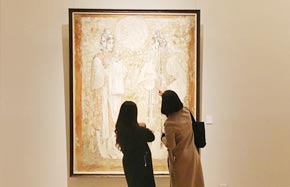
Before he went to Qinghai to accept his poetry prize, he stopped in Shanghai to hold an exhibition of his collages at Minsheng Art Museum.
"I have to admit that selling a collage earns more than writing poems. It's a shame that the art market is overestimated," says Adonis, who always identifies himself as a poet rather than an artist.
Related:
Part-time poets are on the rise
When was the last time you read a poem? Is there someone in your social network who calls himself or herself a poet? More...
Translators need to strike a balance
Cultural identity, the spirit of introspection and writers'mission are among the topics that Syrian-born poet Adonis explored with Nobel Prize winner Mo Yan and other Chinese writers, in a recent talk organized by Beijing Normal University International Writing Center. More...