| 美國和日本兩個獨(dú)立研究小組近日分別宣布,它們的研究人員成功地將人體皮膚細(xì)胞改造成了幾乎可以和胚胎干細(xì)胞相媲美的干細(xì)胞。這一成果有望使胚胎干細(xì)胞研究避開一直以來面臨的倫理爭議,從而大大推動與干細(xì)胞有關(guān)的疾病療法研究。 |
|
|
|
|
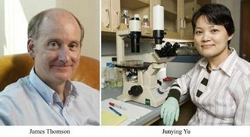
Researchers James Thomson (L) and Junying Yu with the University of Wisconsin-Madison are shown here in University of Wisconsin-Madison photographs. Yu is lead author of a paper describing a novel method of reprogramming adult stem cells to create cells that are indistinguishable from embryonic stem cells. [Agencies]
|
Scientists have made ordinary human skin cells take on the
chameleon-like powers of
embryonic stem cells, a startling breakthrough that might someday deliver the medical payoffs of embryo cloning without the controversy.
Laboratory teams on two continents report success in a pair of landmark papers released Tuesday. It's a neck-and-neck finish to a race that made headlines five months ago, when scientists announced that the feat had been accomplished in mice.
The "direct reprogramming" technique avoids the swarm of ethical, political and practical obstacles that have stymied attempts to produce human stem cells by cloning embryos.
Scientists familiar with the work said scientific questions remain and that it's still important to pursue the cloning strategy, but that the new work is a major coup.
"This work represents a tremendous scientific milestone -- the biological equivalent of the Wright Brothers' first airplane," said Dr. Robert Lanza, chief science officer of Advanced Cell Technology, which has been trying to extract stem cells from cloned human embryos.
"It's a bit like learning how to turn lead into gold," said Lanza, while cautioning that the work is far from providing medical payoffs.
There is a catch. At this point, the technique requires disrupting the DNA of the skin cells, which creates the potential for developing cancer. So it would be unacceptable for the most touted use of embryonic cells: creating transplant tissue that in theory could be used to treat diseases like diabetes, Parkinson's, and spinal cord injury.
But the DNA disruption is just a byproduct of the technique, and experts said they believe it can be avoided.
The new work is being published online by two journals, Cell and Science. The Cell paper is from a team led by Dr. Shinya Yamanaka of Kyoto University; the Science paper is from a team led by Junying Yu, working in the lab of in stem-cell pioneer James Thomson of the University of Wisconsin-Madison.
Both reported creating cells that behaved like stem cells in a series of lab tests.
Thomson, 48, made headlines in 1998 when he announced that his team had isolated human embryonic stem cells.
Yamanaka gained scientific notice in 2006 by reporting that direct reprogramming in mice had produced cells resembling embryonic stem cells, although with significant differences. In June, his group and two others announced they'd created mouse cells that were virtually indistinguishable from stem cells.
For the new work, the two men chose different cell types from a tissue supplier. Yamanaka reprogrammed skin cells from the face of an unidentified 36-year-old woman, and Thomson's team worked with foreskin cells from a newborn. Thomson, who was working his way from embryonic to fetal to adult cells, said he's still analyzing his results with adult cells.
Both labs did basically the same thing. Each used viruses to ferry four genes into the skin cells. These particular genes were known to turn other genes on and off, but just how they produced cells that mimic embryonic stem cells is a mystery.
"People didn't know it would be this easy," Thomson said. "Thousands of labs in the United States can do this, basically tomorrow."
The Wisconsin Alumni Research Foundation, which holds three patents for Thomson's work, is applying for patents involving his new research, a spokeswoman said. Two of the four genes he used were different from Yamanaka's recipe.
Scientists prize embryonic stem cells because they can turn into virtually any kind of cell in the body. The cloning approach -- which has worked so far only in mice and monkeys -- should be able to produce stem cells that genetically match the person who donates body cells for cloning.
That means tissue made from the cells should be transplantable into that person without fear of rejection. Scientists emphasize that any such payoff would be well in the future, and that the more immediate medical benefits would come from basic research in the lab.
In fact, many scientists say the cloning technique has proven too expensive and cumbersome in its current form to produce stem cells routinely for transplants.
The new work shows that the direct reprogramming technique can also produce versatile cells that are genetically matched to a person. But it avoids several problems that have bedeviled the cloning approach.
For one thing, it doesn't require a supply of unfertilized human eggs, which are hard to obtain for research and subjects the women donating them to a surgical procedure. Using eggs also raises the ethical questions of whether women should be paid for them.
In cloning, those eggs are used to make embryos from which stem cells are harvested. But that destroys the embryos, which has led to political opposition from President Bush, the Roman Catholic church and others.
Those were "show-stopping ethical problems," said Laurie Zoloth, director of Northwestern University's Center for Bioethics, Science and Society.
The new work, she said, "redefines the ethical terrain."
Richard Doerflinger, deputy director of pro-life activities for the US Conference of Catholic Bishops, called the new work "a very significant breakthrough in finding morally unproblematic alternatives to cloning. ... I think this is something that would be readily acceptable to Catholics."
Another advantage of direct reprogramming is that it would qualify for federal research funding, unlike projects that seek to extract stem cells from human embryos, noted Doug Melton, co-director of the Harvard Stem Cell Institute.
Still, scientific questions remain about the cells produced by direct reprogramming, called "iPS" cells. One is how the cells compare to embryonic stem cells in their behavior and potential. Yamanaka said his work detected differences in gene activity.
If they're different, iPS cells might prove better for some scientific uses and cloned stem cells preferable for other uses. Scientists want to study the roots of genetic disease and screen potential drug treatments in their laboratories, for example.
Scottish researcher Ian Wilmut, famous for his role in cloning Dolly the sheep a decade ago, told London's Daily Telegraph that he is giving up the cloning approach to produce stem cells and plans to pursue direct reprogramming instead.
Other scientists said it's too early for the field to follow Wilmut's lead. Cloning embryos to produce stem cells remains too valuable as a research tool, Jaenisch said.
Dr. George Daley of the Harvard institute, who said his own lab has also achieved direct reprogramming of human cells, said it's not clear how long it will take to get around the cancer risk problem. Nor is it clear just how direct reprogramming works, or whether that approach mimics what happens in cloning, he noted.
So the cloning approach still has much to offer, he said.
Daley, who's president of the International Society for Stem Cell Research, said his lab is pursuing both strategies.
"We'll see, ultimately, which one works and which one is more practical."
(Agencies/China Daily)
Vocabulary:
chameleon:變色龍
embryonic:胚胎的
(英語點(diǎn)津 Celene 編輯)