 |
|
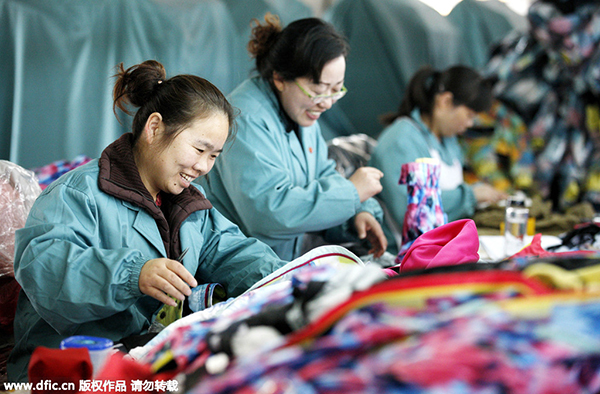
Workers manufacture garment that will be exported to the European Union in Huaibei city, Anhui province, Dec 8, 2015. [Photo/IC] |
The prospect of an economic meltdown in China has been sending tremors through global financial markets. Yet such fears are overblown. While turmoil in Chinese equity and currency markets should not be taken lightly, the country continues to make encouraging headway on structural adjustments in its real economy. This mismatch between progress in economic rebalancing and setbacks in financial reforms must ultimately be resolved as China now enters a critical phase in its transition to a new growth model. But it does not spell imminent crisis.
Consistent with China's long experience in central planning, it continues to excel at industrial re-engineering. Trends in 2015 were a case in point: The 8.3 percent expansion in the services sector outstripped that of the once-dominant manufacturing and construction sectors, which together grew by just 6 percent last year. The tertiary sector rose to 50.5 percent of the country's GDP in 2015, well in excess of the 47 percent share targeted in 2011, when the 12th Five-Year Plan (2011-15), was adopted, and a full 10 percentage points more than the 40.5 percent share of the secondary sector's activities (manufacturing and construction).
This significant shift in China's economic structure is vitally important to its consumer-led rebalancing strategy. Services development underpins urban employment opportunities, a key building block of personal income generation. With the services sector requiring about 30 percent more jobs per unit of output than manufacturing and construction, combined, the tertiary sector's relative strength has played an important role in limiting unemployment and preventing social instability-long China's greatest fear. On the contrary, even in the face of decelerating GDP growth, urban job creation hit 11 million in 2015, against the government's target of 10 million and slightly more than the 10.7 million in 2014.
The bad news is that China's impressive headway on restructuring its real economy has been accompanied by significant setbacks for its financial agenda-namely, the bursting of an equity bubble, a poorly handled shift in currency policy and a flight of financial capital. These are hardly inconsequential developments-especially for a country that must eventually align its financial infrastructure with a market-based consumer society. China will never succeed if it does not sync its financial reforms with its rebalancing strategy for the real economy.
Capital-market reforms-especially the development of more robust equity and bond markets to augment a long dominant bank-centric system of credit intermediation-are critical to this objective. Yet in the aftermath of the stock-market bubble, the equity-funding alternative is all but dead for the foreseeable future. For that reason alone, China's recent financial sector setbacks are especially disappointing.
But setbacks and crises are not the same thing. The good news is that China's massive reservoir of foreign exchange reserves provides it with an important buffer against a classic currency and liquidity crisis. To be sure, China's foreign exchange reserves have fallen enormously-by $700 billion-in the last 19 months. Given China's recent buildup of dollar-denominated liabilities, which the Bank for International Settlements currently places around $1 trillion (for short- and long-term debt, combined), external vulnerability can hardly be ignored. But, at $3.3 trillion in December 2015, China's foreign exchange reserves are still enough to cover more than four times its short-term external debt-well in excess of the widely accepted rule of thumb that a country should still be able to fund all of its short-term foreign liabilities in the event that it is unable to borrow in international markets.
Of course, this cushion would effectively vanish in six years if foreign exchange reserves continue to fall at the $500 billion annual rate recorded in 2015. This was precisely the greatest fear during the Asian financial crisis of the late 1990s, when China was widely expected to follow other so-called East Asian miracle economies that had run out of reserves in the midst of a contagious attack on their currencies. But if it didn't happen then, it certainly won't happen now: China's foreign exchange reserves today are 23 times higher than the $140 billion held in 1997-98. Moreover, China continues to run a large current account surplus, in contrast to the outsize external deficits that proved so problematic for other Asian economies in the late 1990s.
Still, fear persists that if the capital flight intensifies, China would ultimately be powerless to stop it. Nothing could be further from the truth. China's institutional memory runs deep when it comes to crises and their consequences. That is especially the case concerning the experience of the late 1990s, when Chinese leaders saw firsthand how a run on reserves and a related currency collapse can wreak havoc on seemingly invincible economies. In fact, it was that realization, coupled with a steadfast fixation on stability, which prompted China to focus urgently on amassing the largest reservoir of foreign exchange reserves in modern history. While the authorities have no desire to close the capital account after having taken several important steps to open it in recent years, they would most certainly rethink this position if capital flight were to become a more serious threat.
Yes, China has stumbled in the recent implementation of many of its financial reforms. The equity market fiasco is especially glaring in this regard, as was the failure to clarify official intentions regarding the August 2015 shift in exchange rate policy. These missteps should not be taken lightly-especially in light of China's high-profile commitment to market-based reforms. But they are a far cry from the crisis that many believe is now at hand.
The author is a faculty member at Yale University and former chairman of Morgan Stanley Asia. He is also the author of Unbalanced: The Codependency of America and China.
Project Syndicate



I’ve lived in China for quite a considerable time including my graduate school years, travelled and worked in a few cities and still choose my destination taking into consideration the density of smog or PM2.5 particulate matter in the region.
Copyright 1995 - . All rights reserved. The content (including but not limited to text, photo, multimedia information, etc) published in this site belongs to China Daily Information Co (CDIC). Without written authorization from CDIC, such content shall not be republished or used in any form. Note: Browsers with 1024*768 or higher resolution are suggested for this site.
License for publishing multimedia online 0108263 Registration Number: 130349