Mexican standoff









China, Mexico and the US are all set to be losers if the new Trump administration implements its proposed policies
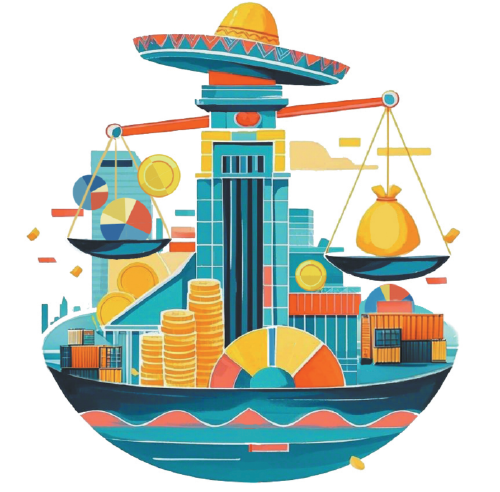
Donald Trump's second term is set to dramatically change US foreign policy priorities, as his focus is on economic protectionism and political isolation. In fact, Trump will continue the "Make America Great Again" trend initiated by himself in 2017, but followed by Joe Biden afterwards. This will negatively impact global adversaries and partners alike, and in the case of the China-United States-Mexico triangle, it seems to be reaching a Mexican standoff in the Trump's second term.
Basically, a Mexican standoff is a situation in which no party can achieve victory.
The standoff among China, Mexico and the US was initiated by Trump during his first term. At the time, the US triggered trade wars against both China and Mexico. Additionally, Trump forced Canada and Mexico to renegotiate the North American Free Trade Agreement, which resulted in the US-Mexico-Canada Agreement. The USMCA, with few but important changes, is one of the most significant, and the notorious Article 32.10, which prevents any party of the USMCA signing trade agreements with non-market economies, the so-called anti-China clause. As needless to say, China has been one of the main trade partners of both Canada and Mexico in the last decade.
The new Trump administration may guide the US to its most trade protectionist period in nearly a century, according to some reports. During his 2024 campaign, Trump proposed tariffs of about 20 percent on global imports, 25 percent on Canadian and Mexican imports, and 60 percent tariffs on all Chinese imports. Beyond the commercial logic, Trump has announced tariffs to pressure China and Mexico to address migration and drug trafficking.
Trump's rhetoric has already provoked reactions from both China and Mexico. In November, the Mexican government announced reciprocal one-by-one tariffs facing Trump's announcements, with President Claudia Sheinbaum declaring that "one tariff will follow another in response and so on, until we put our common businesses at risk". Similarly, in early 2025, the Chinese government announced measures on 28 US entities and the addition of some US companies to the export control list in order to safeguard its national security and interests.
Nevertheless, also in November, Mexican President Sheinbaum communicated a plan to substitute Chinese imports. Then, Mexico announced the imposition of 35 percent tariffs to global textiles imports, of which China is the origin of one-third. In January 2025, Mexico imposed a 19 percent tariff on e-commerce products coming from countries with no trade agreement with Mexico, affecting in particular Chinese brands such as Temu and Shein. In contraposition to the free trade principle that Mexico has traditionally followed — the Latin American country has 14 free trade agreements with 50 countries — all of the mentioned actions have been reactions to Canada and US pressure to reduce the Chinese presence in North America.
To be precise, the Mexican standoff is manifested when Mexico is obligated to act against China to the potential detriment of its own economy. First of all, the increase of tariffs on textiles and e-commerce products affects consumers and isolates Mexico from the global production chains that have benefited Mexican exports. It is well known that a large portion of Mexico's trade deficit with China is transformed into Mexico's surplus with the US. Second, to prioritize North America is to foment dependency on a single market, which may hinder Mexico's geopolitical autonomy. Third, even though China and Mexico have managed to adapt their trade and investment relations up till now, the new Trump administration may force China and Mexico to move away from each other, damaging a historic and important bilateral relationship.
By way of example is the automotive industry dynamics within the China-US-Mexico triangle. One of the key differences between the NAFTA and the USMCA is country-of-origin rules in order to enjoy tariff-free status. The requirement for North America-made components increased from 62.5 percent to 75 percent. In 2023, the Mexican government announced the construction of Tesla's Gigafactory, but in mid-2024 Tesla announced that this facility will be put on hold due to macroeconomic concerns. In contrast, BYD has gone from being an unknown brand in Mexico to be part of popular brands in new car sales — 50,000 units sold in 2024 — a situation that reflects consumption preferences. This could lead to many win-win projects, such as learning from China's experience of innovation, more investments and joint ventures.
As it can be seen, in the China-US-Mexico triangle, the US is trying to contain China by provoking a lose-lose game, and forcing Mexico to sacrifice its own interests in this confrontation, which will certainly bring greater losses to Mexico's interests. Mexico should keep a clear mind about this and make the right decision based on its own development needs, instead of following the US' order to damage Mexico-China economic ties. The US tariff measures will not benefit the US, Mexico and China, but only disrupt global trade stability as well as the interests of these three countries.
The author is an associate professor and researcher at the Politics and Culture Department at the Metropolitan Autonomous University, Xochimilco campus. The author contributed this article to China Watch, a think tank powered by China Daily. The views do not necessarily reflect those of China Daily.
Contact the editor at editor@chinawatch.cn.