Mobility fuels Yangtze River Delta region integration









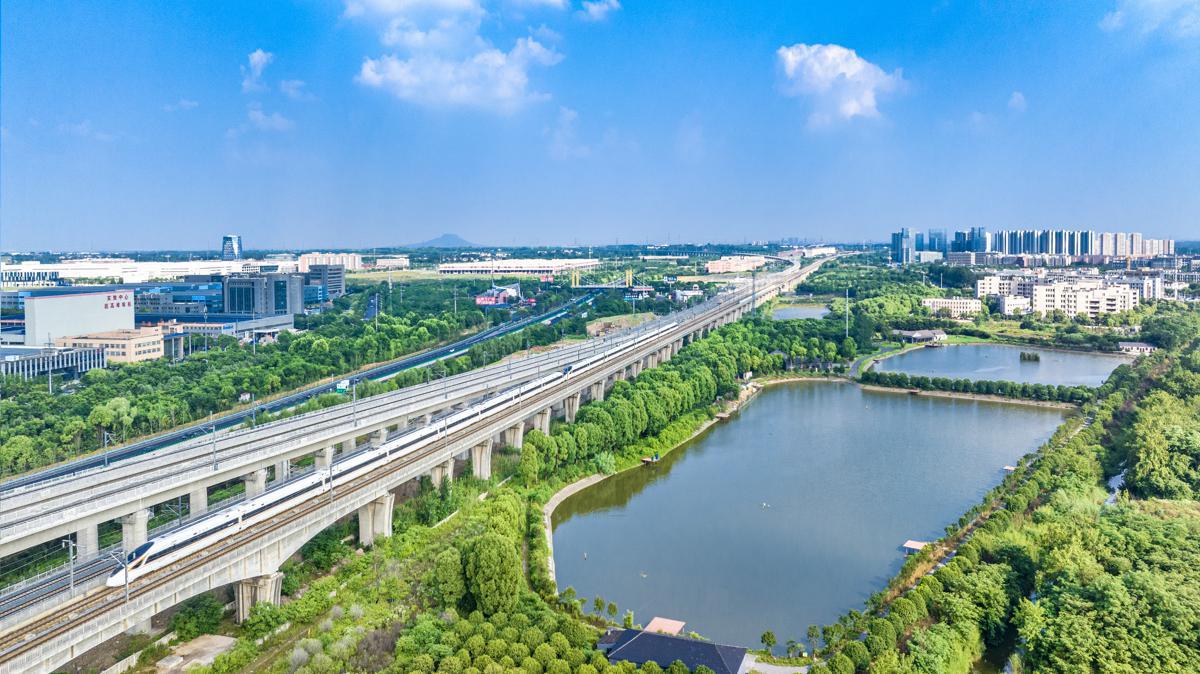
A young engineer gets off a high-speed train in Shanghai, buys a cup of coffee, gets on a metro and heads to the office. On his way back, he completes the commute in reverse to reach home in Suzhou for supper. Twenty years ago, such a round trip would have taken an entire day. Today it is routine. This "twin-city" lifestyle — working in one city, living in another — is an indicator of profound institutional changes across the Yangtze River Delta region.
What looks like an individual decision about housing and transport is in fact the visible tip of a far larger process: mechanism innovation and coordinated development that are knitting the region into a close, productive whole.
Inter-provincial commuting is the human face of regional integration. With the rapid development of high-speed and intercity rail services linking Shanghai and Jiangsu, Zhejiang and Anhui provinces, commutes that once took more than two hours now take less than an hour. As a result, more and more people in the region are routinely crossing provincial borders to access better jobs or more affordable housing.
As of Dec 26, 2024, the Yangtze River Delta region's railway operating mileage exceeded 15,000 kilometers. The result: people can live where life is peaceful and less expensive and still work in international-level cities. This flexibility has improved people's living standards, widened labor markets and improved economic efficiency in the region.
But infrastructure alone does not explain the change. The deeper story is institutional: how the YRD region has innovated mechanisms to eradicate old administrative frictions and allow resources to flow.
From coordinated transport timetables to cross-provincial social insurance settlement and joint enforcement of industrial standards, these innovations have ensured that cities no longer function as isolated administrative entities but as collaborative partners.
The payoff is visible across the country. Faster, more reliable connections have catalyzed cross-regional labor flow, especially of higher-skilled professionals, and mobility has accelerated industrial upgrading. Shanghai's clustering of finance and technological R&D attracts engineers and entrepreneurs from Jiangsu, Zhejiang and Anhui. Those people in turn seed innovation back into their home provinces, improving manufacturing and creating new markets for digital services.
In areas such as integrated circuits, AI and biopharmaceuticals, the YRD region accounts for a disproportionate share of national capacity — a concentration that reflects both infrastructure investments and policies to align comparative advantages. Technology transfer figures and joint research outputs testify to an ecosystem in which sales, R&D and manufacturing complete a geographically broader but functionally tighter loop.
This complementary development is not accidental. Shanghai's strengths in finance and platform services complement Zhejiang's prowess in digital transformation and Jiangsu's deep manufacturing base. When better policies and improved transportation are combined, the whole becomes more than the sum of its parts: Jiangsu manufacturers digitalize with Zhejiang partners, Zhejiang firms scale via Shanghai's financial markets, and Anhui contributes talent and new production capacity.
In 2023, for example, technology contracts and collaborative research between Shanghai and its neighboring provinces accounted for a substantial share of the region's intra-regional technology commerce, while tens of thousands of jointly authored international scientific papers and thousands of patent applications underline the depth of cooperative innovation. These developments show that commuting is not only a quality-of-life issue; it is a mechanism for economic integration.
The YRD region's approach is pragmatic and sequential. First, build connectivity to reduce time and space; second, reform rules and procedures to eradicate institutional frictions; third, promote industrial alignment so that comparative advantages find complementary partners; and fourth, ensure public services, from healthcare portability to education cooperation, and serve the people rather than trap them. When these four lines of reform — infrastructure, policy, industry and public services — advance together, mobility, that is, the movement of people, generates productivity gains, not social dislocation.
These are the broader lessons other city clusters and countries wrestling with regional inequality can learn from the YRD region. Infrastructure alone cannot lead to integration; it must be matched by mechanisms that make cross-border commute manageable and affordable. The YRD region shows how targeted institutional innovation, not one-size-fits-all reform but calibrated coordination, can leverage investment in transportation into economic cohesion.
Seen from China's perspective, the YRD region's experience also highlights the role of strategic design. Rather than leaving integration to market forces alone, regional planners have used policy levers to lower the costs of collaboration and raise the returns on collective action. This approach is consistent with China's broader aim of achieving high-quality development through planned reform, where incentives and infrastructure are aligned to facilitate both efficiency and shared prosperity.
The 14th Five-Year Plan (2021-25) period has already borne this out: the YRD region's integration advanced markedly, laying a solid foundation for high-quality regional growth and providing lessons for wider cooperation.
However, challenges remain. Harmonizing regulations, balancing fiscal responsibilities, and ensuring social support across wider geographies are difficult, ongoing tasks. Yet the evidence is clear: by making inter-provincial commuting manageable and desirable, the YRD region has triggered a virtuous circle of human mobility, industrial upgrading and institutional innovation. The 15th Five-Year Plan (2026-30) is expected to push this further, from deeper cross-provincial collaboration to stronger innovation capacity and more secure supply chains.
Large structural changes often become visible through ordinary routines. The commuter who moves between two cities for work is not only pursuing a better life. He/she is rewiring the economic geography of the region. In this sense, "twin-city living" is both a symptom and an engine of integration, which has turned infrastructure and policy into a new model of regional development. The YRD region offers a practical, China-rooted template: build the rails, but also build the rules, and let people and ideas ride them.
The author is director of the Yangtze River Delta cultural industry research institute at Nanjing University.
The views don't necessarily represent those of China Daily.
If you have a specific expertise, or would like to share your thought about our stories, then send us your writings at opinion@chinadaily.com.cn, and comment@chinadaily.com.cn.