

|
|
 |
 Raymond Zhou:
By jingo, they're mad!  Op Rana:
Consumerism and politics of waste   Ravi S. Narasimhan:
Lessons from SARS have to be applied  Alexis Hooi:
Beyond the death and destruction  The way we were
By Raymond Zhou (China Daily)
Updated: 2008-12-18 07:45
 How we dressed The Chinese word for "fashion" was in limbo 30 years ago, but the idea was being awakened - or reawakened. Young men liked the kind of trousers John Travolta wore in Saturday Night Fever even though nobody had heard of the movie. Bell-bottomed pants became a badge of youthful rebellion. The urge to break free of the tyrannical color scheme of blue, black and gray was palpable. Yet, like many other things, fashion liberation was achieved in fits and starts. In some cities, fashion police, armed with scissors, went on the street and cut the bell-bottoms off people's pants. Before China's opening up and reform, Dacron and fake collars were the hallmarks of sartorial savoir-faire among the urban Chinese. Because cotton was dclass, the wrinkle-resistant polyester became the preferred fabric of a whole generation. Most people, even urbanites, could only buy new clothing once a year, usually before Chinese New Year. And like all basic commodities, fabric was rationed, which means, even if you had money you could buy only a limited amount. That gave rise to fake collars. Presumably in fashion-conscious Shanghai, where people could not stand to wear the same clothes weeks at a time, some genius invented a "fake collar". This was a misnomer because the collar was the only part of the shirt that was real. The rest of the shirt was non-existent. Since people wore it in winter, with a sweater over it, they could give the impression of more wardrobe changes without stealing their neighbors' ration coupons. The collar went out of existence as soon as we crossed the threshold into material sufficiency. It's now become a collector's item. People born in the age of abundance can't imagine an invention like that, let alone as a "fashion item". Speaking of fashion, Pierre Cardin brought over a dozen models from Paris and staged a show in Beijing in 1979. The 1980s was marked by a sudden blossoming of bright colors, which, in retrospect, looked quite tacky as people back then had no sense of how to match colors. People just no longer wanted to be engulfed in a sea of dark colors. Surprisingly, jeans did not encounter the same ideological hurdle as bell-bottoms. My parents thought they were the same as China's "work cloth", looking sturdy and honest, instead of the fluffy and ubiquitous red and yellow. And when torn, they looked really working-class.
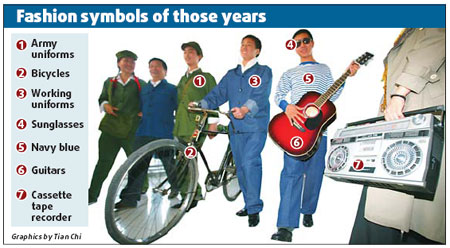 The re-emergence of the Western suit in 1980s was another milestone. People, usually those taking official trips abroad, were given a special allowance to have suits tailor-made. When I spotted them in a crowd of hundreds in San Francisco, I could tell instantly which suit was made in China. It took a long time before those going abroad gave up these crummy suits. Nowadays, it is the trademark of a migrant worker. In the late 1980s, there was a burst of "culture shirts" - T-shirts with funny or sarcastic slogans printed on them. Its popularity ensured its demise through official pressure. Fashion trends usually start in metropolises like Shanghai and Guangzhou and then spread inland. You can gauge the distance by estimating which fashion was in vogue in the big cities. Things started to change in the 1990s. With growing migration and media penetration, the gap gradually vanished, and there's so much diversity now it's easier to guess, from what one wears, his profession rather than his background. 
|
主站蜘蛛池模板: 靖西县| 偃师市| 林州市| 武威市| 汽车| 阳春市| 石门县| 简阳市| 饶阳县| 云和县| 荣昌县| 通山县| 中超| 自贡市| 嵩明县| 潜江市| 古交市| 伽师县| 黄陵县| 汝阳县| 陆河县| 交城县| 大田县| 镇康县| 行唐县| 柳河县| 靖江市| 莒南县| 独山县| 甘泉县| 普兰店市| 环江| 永新县| 甘肃省| 平乡县| 江达县| 庆安县| 台前县| 仁寿县| 乌什县| 江门市| 台南市| 三江| 兴海县| 辽宁省| 邯郸市| 龙川县| 临武县| 泰州市| 泸定县| 南开区| 北流市| 天气| 广安市| 大城县| 珲春市| 普兰店市| 绥江县| 洛川县| 濮阳县| 新蔡县| 顺平县| 张掖市| 虞城县| 武邑县| 麻栗坡县| 项城市| 巧家县| 海原县| 永昌县| 和平区| 大港区| 嘉义市| 罗平县| 信宜市| 安阳市| 宜兰县| 田林县| 贺兰县| 玉环县| 西藏| 四平市|




